What is IC Programming?
IC (Integrated Circuit) Programming, also called IC burning or firmware loading, is the process of writing software/firmware code, configuration data, or calibration settings into non-volatile memory embedded within an integrated circuit. This transforms a “blank” IC into a functional component ready for installation on a PCB.
Here’s a breakdown of key aspects:
1. What Gets Programmed?
Microcontrollers (MCUs) & Microprocessors (MPUs): Bootloaders, firmware, OS kernels.
Memory ICs:
EEPROM/Flash: Store device firmware (e.g., BIOS in PCs).
OTP (One-Time Programmable) Memory: Permanent code for industrial sensors.
Programmable Logic Devices:
FPGAs: Configuration bitstreams.
CPLDs: Logic definitions.
Peripheral ICs:
Wi-Fi/BT Modules: Network stacks, MAC addresses.
Sensors: Calibration data (e.g., for medical devices).
2. Programming Methods
Offline Programming (Chip-Level):
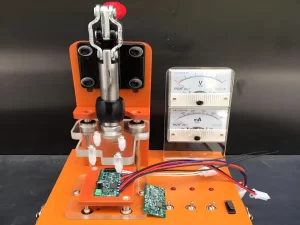
ICs are programmed before assembly onto circuit boards using adapters/programmers (e.g., ALL-100 programmer). Suitable for high-volume production but requires chip removal for rework.
Online Programming (Board-Level):
ICs are programmed after assembly onto PCBs using interfaces like JTAG, UART, or SWD. Allows in-circuit updates without disassembly, reducing damage risk and cost.
Advanced Techniques:
ISP (In-System Programming): Directly programs chips on the board via serial interfaces.
IAP (In-Application Programming): Enables remote firmware updates (e.g., IoT devices)
Table: Comparison of Programming Methods
| Method | Tools Required | Use Case | Advantages/Limitations |
|---|---|---|---|
| Offline | Adapters, programmers | Pre-assembly, mass production | ✅ High speed; ❌ Adapter cost, chip removal needed |
| Online (ISP) | Debug probes, cables | Post-assembly, prototypes | ✅ No disassembly; ❌ Slower for large batches |
| IAP | Communication interfaces | Field updates (remote devices) | ✅ Remote updates; ❌ Requires bootloader support |

3. Critical Steps
Code Compilation: Convert source code to binary (hex/bin files).
Hardware Setup: Connect programmer to IC via interfaces:
JTAG: Industry standard for debugging/programming.
SWD: Simplified 2-wire alternative (ARM devices).
UART/I²C/SPI: Common for simpler ICs.
Validation:
Checksum Verification: Confirm data integrity.
Device ID Check: Ensure correct IC model.
Functional Test: Run a minimal firmware routine.
4. Industry Applications
Automotive: Programming ECUs (Engine Control Units) with calibration data.
Medical Devices: Loading FDA-approved firmware into insulin pumps.
Consumer Electronics: Burning Android OS onto smartphone SoCs.
IoT: Configuring unique device IDs & security certificates.
5. Challenges & Solutions
Challenge Solution
Compatibility Issues Use universal programmers (e.g., Xeltek).
Secure Firmware Encrypt binaries; use secure bootloaders.
High-Volume Production Gang programming + automated handlers.
Firmware Updates Design OTA-capable hardware (e.g., ESP32).
Key Tools
Hardware:
Dedicated programmers (e.g., TL866, PICKit).
Debug probes (e.g., SEGGER J-Link, ST-Link).
Software:
IDE plugins (STM32CubeProgrammer, MPLAB X).
Open-source tools (OpenOCD, pyOCD).
Why It Matters
A correctly programmed IC ensures:
Device functionality (e.g., a smartwatch booting).
Hardware security (e.g., preventing firmware theft).
Compliance (e.g., meeting medical/automotive standards).
A programming error can brick devices or cause field failures.
For complex projects, IC programming is often integrated into the PCBA test line, where boards are powered up, programmed, and validated in one automated sequence.